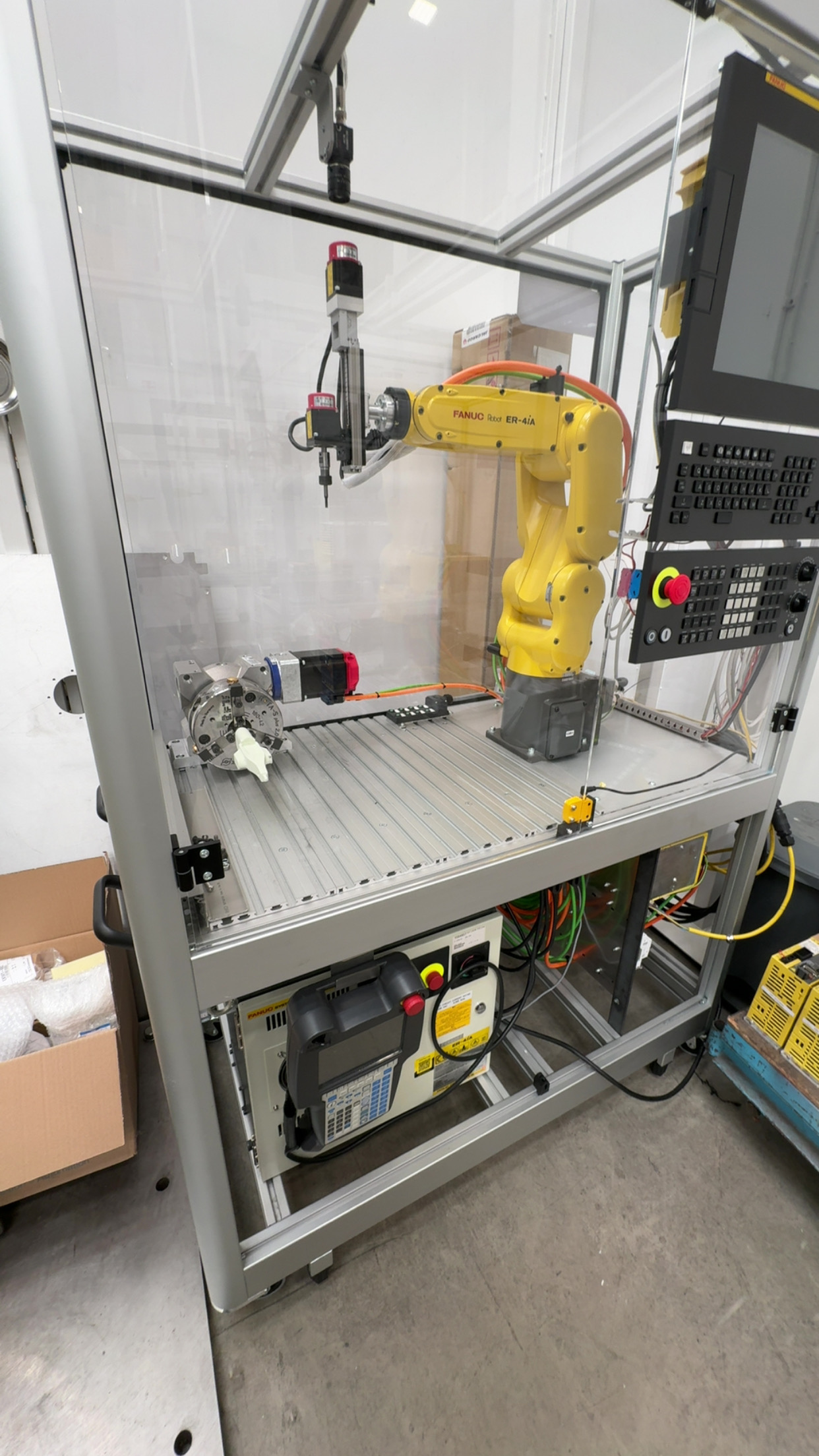
FANUC integration that goes further than the robot running.
Getting a FANUC robot to move is not the hard part. Getting it to work reliably inside a production cell — loading and unloading machines, handling edge cases, recovering cleanly from faults, and handing off correctly to whatever is upstream and downstream — that is the engineering.
The part most integrators gloss over: the machine side.
CNC machine tending is the majority of what FANUC integration looks like in practice. I have worked extensively on tending Doosan and FANUC CNC machines, and on a range of other machine types where the integration follows the same pattern: modify the machine’s PLC to send a structured request signal to the FANUC controller, define the handshake clearly, and build the robot-side logic to respond to it correctly.
That last part — the PLC-side work on the machine being tended — is often overlooked. A robot integration that requires the machine operator to work around the robot is not a finished integration. The machine program needs to be adapted, not just the robot program.
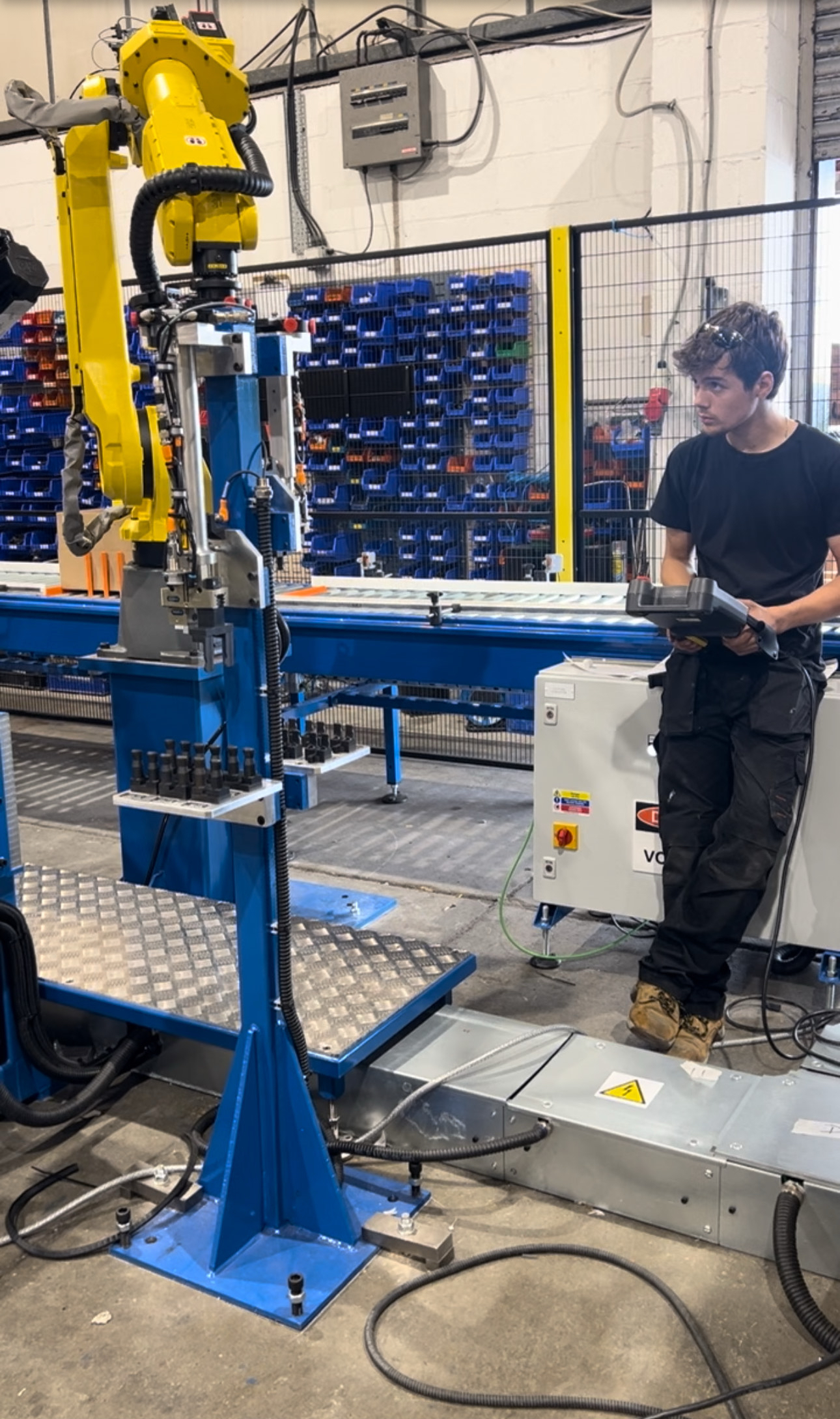
What tending integration covers
- Machine PLC modification to generate a structured request signal
- FANUC controller programming — load, unload, part-present checks, cycle start
- Handshake design: what each side needs to know before it acts
- Fault response — what happens when the machine is not ready, the gripper drops a part, or the door does not confirm
- Testing with realistic cycle times and fault injection before handover
Wider cell scope
- Full cell builds from layout input through to commissioning
- Recommissioning after line changes or machine relocation
- Fault diagnosis and recovery logic for cells that were never quite right first time
- Multi-robot and mixed-machine coordination where more than one robot or machine type is involved
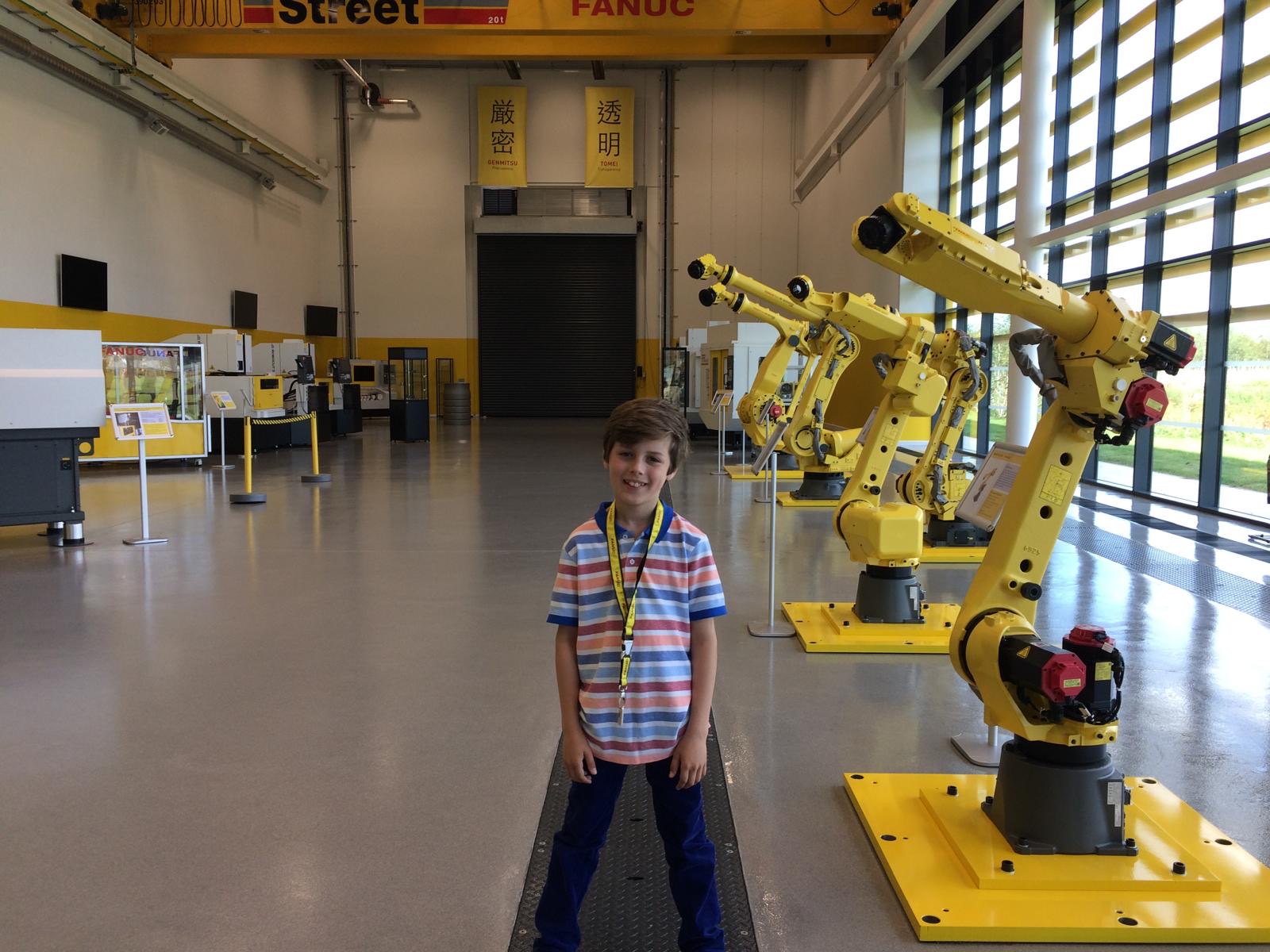
Context that comes from inside the manufacturer’s own engineering team.
For a period I worked alongside FANUC UK’s own engineering team, delivering projects to their customers. I cannot discuss those clients, but working inside that team gave me a clear picture of how FANUC approaches integration at a product and process level — useful context when working independently on FANUC hardware.
I have delivered robot integration work across 5+ projects for Unison Ltd, covering different robot models, cell configurations and machine types. The breadth matters because FANUC cells are rarely identical: the principles carry over, but the specifics always need engineering.
Robot range experience
- Experience across the FANUC robot range — from compact models through to larger payload systems
- Roboguide simulation for layout, reach and cycle time verification before hardware commitment
- Vision integration where applicable
- Safety system integration — area scanners, light curtains, safety PLCs
Recovery logic — the part that matters most
The measure of a finished cell is not whether the robot cycles — it is whether the cell runs without an automation engineer in the building. Recovery logic, fault trees, and documented restart procedures are not afterthoughts. They are what separate a cell that runs in production from one that needs a babysitter.
Two FANUC robots in our own workshop — development and training without client hardware.
We run two FANUC robots in our internal automation cell. This matters for two reasons.
First, software and logic development does not have to wait for a client machine to be available. New handshake structures, recovery logic, and interface approaches can be built and tested on our own hardware before they go anywhere near a production environment.
Second, it is where we run training. If your team needs to understand how to operate, fault-find, or modify a FANUC cell, we can do that on our own equipment rather than on yours.
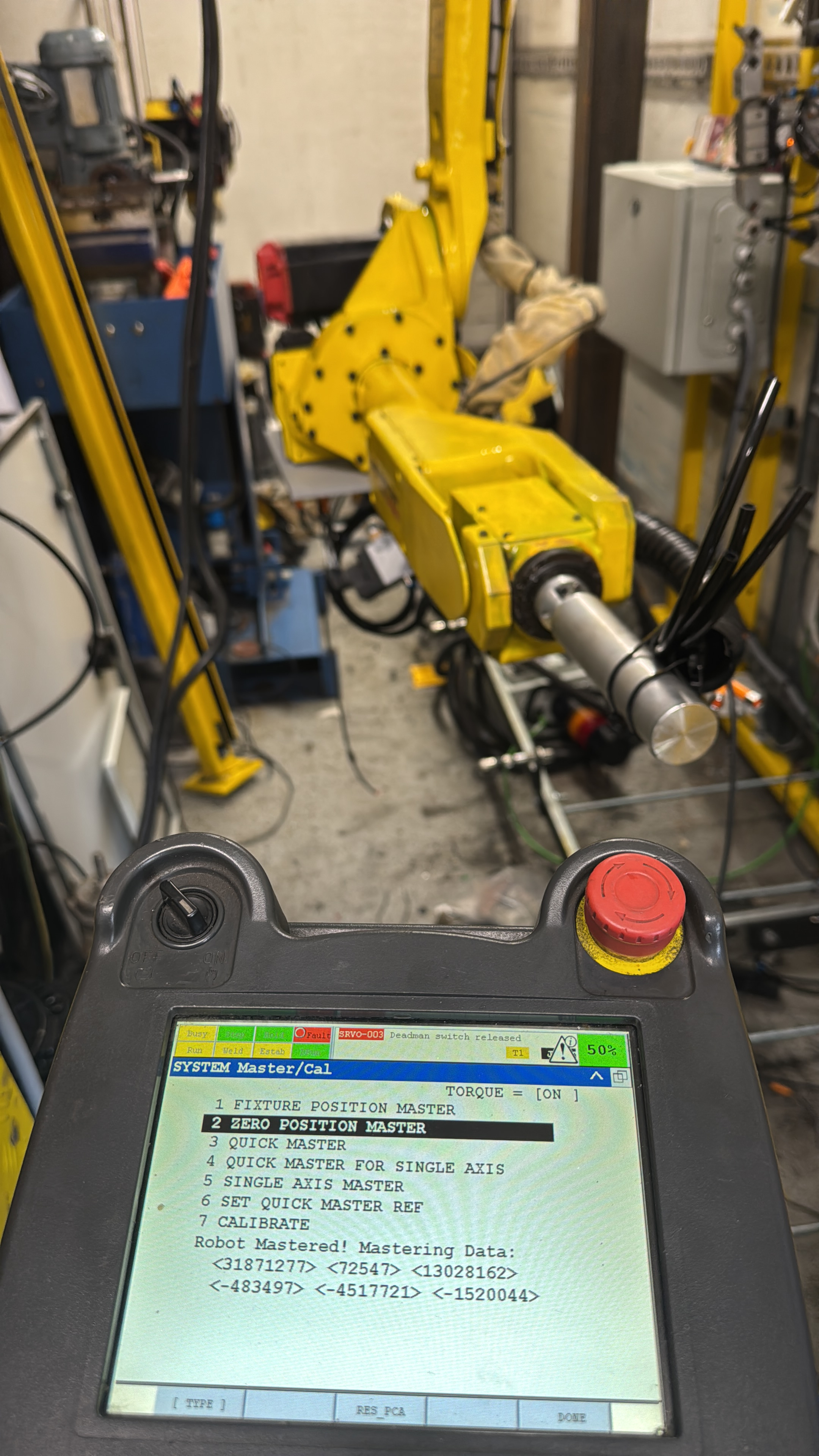
What the cell is used for
- Developing and testing integration logic before deploying to a client machine
- Demonstrating FANUC capabilities to prospective clients
- Hands-on training for teams learning to operate or maintain FANUC systems
- Roboguide simulation work verified against real hardware
International scope
I am UK-based and have delivered FANUC integration projects internationally, including commissioning work on-site in the USA. If the cell is outside the UK, travel is a straightforward conversation.
Tell me about your cell
Whether you are planning a new cell, troubleshooting an existing one, or picking up a project that stalled — describe the robot model, the machine being tended, and where things stand. I will tell you what is involved and whether I am the right fit.
Related services: PLC Retrofit & Re-ControlsSiemens Motion ControlTraining & Consultancy